

The best time to visit Nepal: a local's honest guide
Most travel guides will tell you the same thing: visit Nepal in October or March. They're not wrong. But they're not telling you the whole story either.
I was born and raised in Nepal. I've watched the mountains in every season, celebrated every major festival on the calendar, and guided private guests through landscapes that look entirely different depending on when you arrive. The truth is that Nepal rewards visitors in every month of the year — if you know what you're looking for.
This is the guide I wish every traveler had before they booked.
Why the "best time" question is more complicated than it seems
Nepal is not one place. It is many places stacked on top of each other — subtropical lowlands in the Terai, temperate valleys in the middle hills, and high-altitude Himalayan terrain above 4,000 metres. What is perfect weather in Kathmandu can be a whiteout on the Annapurna Circuit. What feels cold in Pokhara is mild compared to the Upper Mustang plateau.
The best time to visit Nepal depends entirely on where you want to go and what you want to feel.
The seasons, honestly
October to November — the classic window
This is when Nepal is at its most cinematic. The monsoon has just ended, the air is washed clean, and the Himalayan panoramas are as sharp and vivid as they ever get. Rhododendrons are gone but the light is extraordinary — golden and cool. Temperatures are comfortable at altitude and warm in the valleys.
October also carries Dashain and Tihar, Nepal's two most important festivals. If you time your arrival right, you will witness the country at its most alive — streets decorated, families gathered, rituals performed that have continued for centuries. For a private cultural journey, this window is unmatched.
The caveat: you will not be alone. The trekking trails and Kathmandu guesthouses fill up. For private travelers, this means planning further ahead — but it does not diminish the experience.
Best for: Himalayan trekking, cultural immersion, photography, first-time visitors.
March to April — the second season
Spring brings warmth back to the hills and something the autumn cannot offer: colour. The rhododendron forests across the Annapurna and Langtang regions bloom in deep reds and pinks — one of the most quietly spectacular natural displays in Asia. Lower trails are lush and green.
Visibility is generally good in March, softening slightly by late April as pre-monsoon haze begins to build. The air feels more alive than the crisp stillness of autumn — warmer, more fragrant, and carrying the sense that the mountains are waking up again.
Holi falls in March, transforming Kathmandu into an entirely different city for a day — chaotic, joyful, and unlike anything else on the Nepali calendar.
Best for: Rhododendron trekking, photography, Holi festival, families with children.
December to February — the quiet season most travelers overlook
This is Nepal's best-kept secret. The crowds are gone. The lodges are quieter. The air is cold and crystal clear, and on still mornings, the Himalayan views from Nagarkot or the Annapurna foothills are as good as anything the peak seasons offer.
Lower-altitude destinations — Kathmandu, Pokhara, Chitwan, the Kathmandu Valley temples — are perfectly comfortable. Trekking at high altitude requires more preparation and layering, but the solitude on the trails is a genuine luxury that money cannot buy in October.
For couples and small private groups who value privacy over convenience, winter is quietly one of the finest times to experience Nepal. You move through the country at your own pace, without the competition for guides, vehicles, or lodge rooms that the peak months bring.
Best for: Luxury private travel, cultural exploration, low-altitude trekking, Kathmandu Valley.
June to September — the monsoon
The monsoon is not for everyone — and most international travelers avoid it entirely. But I want to be honest about what it actually offers, because some of Nepal's most beautiful landscapes exist only because of the rain.
The Terai — Nepal's southern lowland region, home to Bardiya National Park and Chitwan — is lush, green, and teeming with wildlife during the monsoon. The rhododendron forests glow. The waterfalls are at full force. Kathmandu's festivals continue regardless of the rain, and the city takes on a different, more intimate character when the tourist volumes drop.
Upper Mustang, uniquely, sits in a rain shadow beyond the Himalayas and remains dry and trekable throughout the monsoon. If you want the most extraordinary landscape in Nepal with virtually no other travelers, June through August in Mustang is the answer.
Best for: Upper Mustang, wildlife in Bardiya and Chitwan, those who want Nepal entirely to themselves.
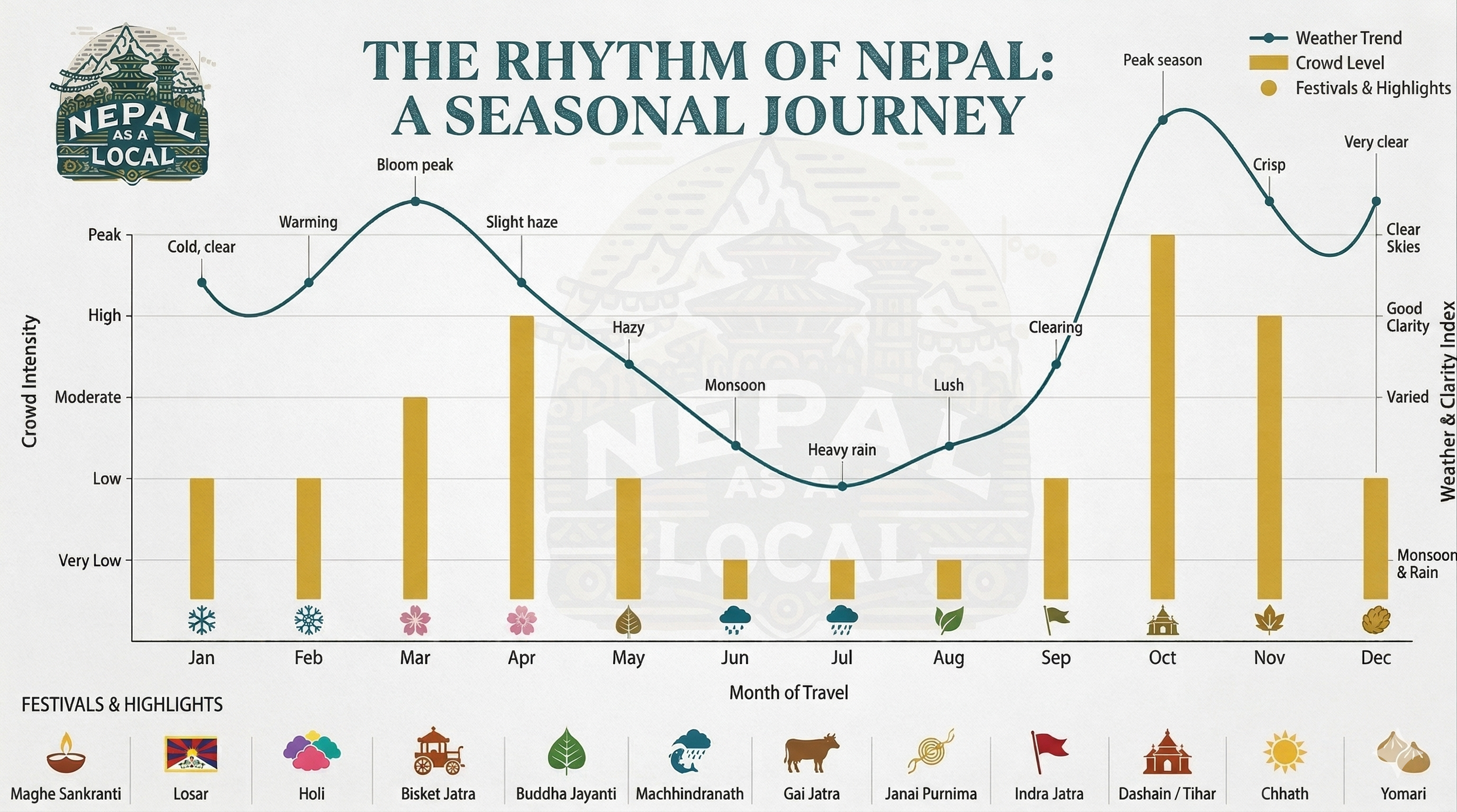
Most guides give you the same two seasons. A local breaks down every month of the year — festivals, weather, crowds, and the windows most travelers never know about.
The question I always ask first
Before I recommend a time, I ask every guest the same thing: what do you want to feel when you are here?
If the answer is awe — that specific sensation of standing in front of something so vast it makes you quiet — then October or March, in the high terrain, is your answer.
If the answer is connection — meals in local homes, festivals unfolding around you, moments that feel genuinely unscripted — then timing around Nepal's cultural calendar matters more than the weather forecast.
If the answer is solitude — a journey that feels entirely your own, with no other traveler in sight — then the low season, in the right destination, will give you something the peak months simply cannot.
Every month has something to offer. The right time to visit Nepal is when it aligns with what you are actually seeking.
At Nepal as a Local, every journey is timed around you — your preferences, the experiences you want, and the Nepal you are ready to discover. If you'd like to explore when your journey might begin, we'd love to hear from you.