

Dal bhat and beyond: the honest guide to eating in Nepal
Here is the honest truth about eating in Nepal: most visitors do it badly.
Not because the food is difficult or obscure. Because the tourist infrastructure around food in Nepal — the pasta-and-pizza menus in Thamel, the "continental breakfast" options at hotels built for foreign comfort — makes it very easy to spend ten days in one of Asia's most interesting food cultures and leave having eaten almost none of it.
This guide is designed to prevent that. It is written by someone who grew up eating this food, not someone who visited for two weeks and made a list. It covers what to eat, where to eat it, what the food actually means, and — perhaps most importantly — what you will miss if you do not look beyond the obvious.
Start here: understanding what Nepali food actually is
Nepal's cuisine is not a single tradition. The multi-ethnic and multi-cultural character of Nepal offers an almost unlimited range of cuisines based on region, religion, ethnicity, culture, festivals, environment, and diverse climatic conditions.
What this means in practice is that the food you eat in the Kathmandu Valley is fundamentally different from what you eat on a high-altitude trek in the Mustang plateau, which is different again from what is eaten in the Terai lowlands to the south. Nepal is a vertical country — its geography shifts from tropical jungle to Arctic plateau within a few hundred kilometres — and its food shifts with it.
Nepali food is shaped by altitude, from the rice paddies of the Terai lowlands to the barley and buckwheat of high Himalayan villages. The cuisine blends Indian, Tibetan, and indigenous Newari traditions into a uniquely comforting mountain fare.
The spices that define the flavour of Nepali cooking are specific and worth knowing. The Nepalese commonly use garlic, cumin, ginger, coriander, turmeric, nutmeg, bay leaves, black pepper, onions, and chillies, along with Himalayan spices like Timur — Szechwan pepper — and Jimbu, a rare herb that gives dishes a unique aroma found almost nowhere else.
Understanding this geography is the foundation of eating well in Nepal. The food is not uniform. It rewards curiosity.
Dal bhat: the most important meal you will ever underestimate
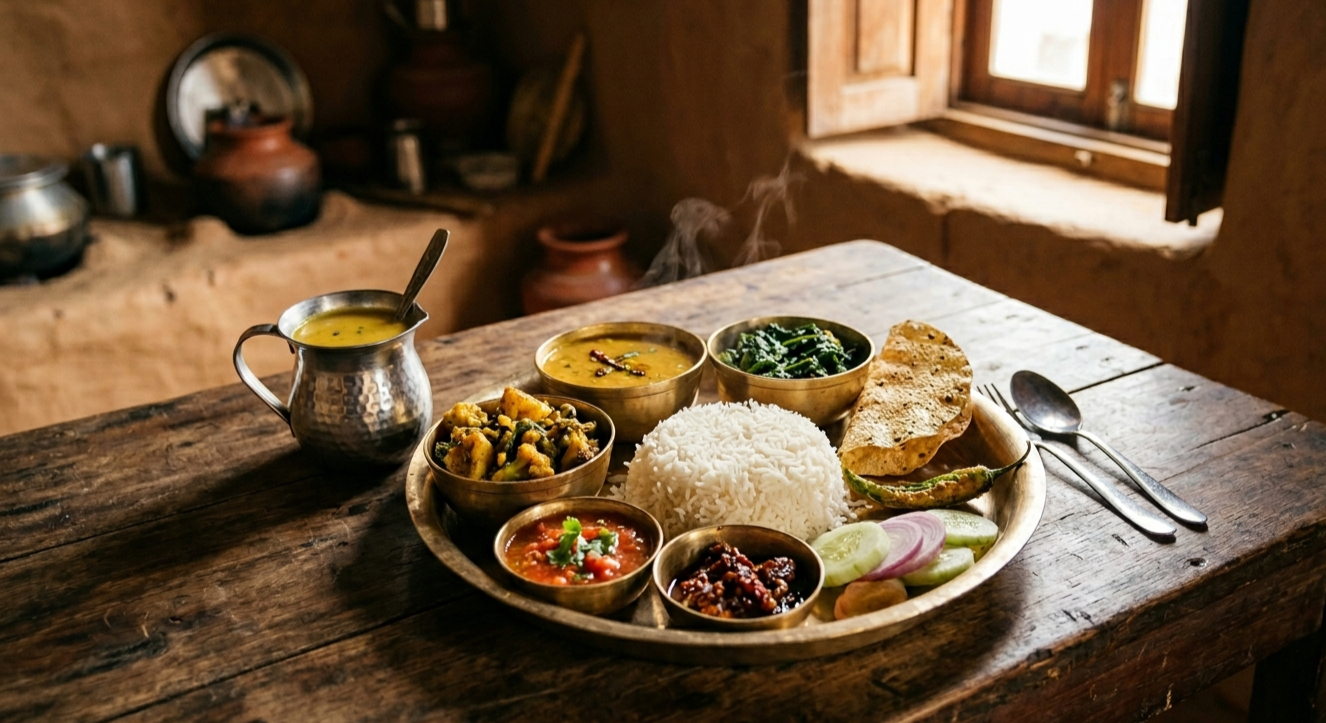
Nepalese traditional Dal Bhat Meal that powers 24 hour
Dal bhat tarkari stands as the foundation of all famous Nepali dishes. Millions of Nepalis eat it daily, regardless of region or background. This complete meal includes steamed rice, lentil soup, seasonal vegetables, and side items such as pickle or curd. It offers protein, carbohydrates, fibre, and minerals in one plate. The phrase "Dal Bhat Power, 24 Hour" reflects its importance — farmers, trekkers, and workers rely on it for strength.
Let me tell you what dal bhat actually is, because the description — rice, lentils, vegetables — undersells it almost comically.
The rice is freshly cooked, never reheated. The dal is not a thin soup but a deeply spiced lentil broth that has been cooked slowly with garlic, ginger, turmeric, and a tempering of cumin seeds in hot ghee poured over the top at the last moment — the sizzle of that tempering is one of the finest sounds in Nepali cooking. The tarkari is a vegetable curry that changes by season, by region, and by household. The achar — pickle — is not an afterthought but a carefully made condiment that provides the sharp, bright note that balances everything else.
What makes dal bhat iconic is its balance. Carbohydrates, proteins, vitamins, and flavours all come together, making it hearty and wholesome. Dal bhat is far more than just rice and lentils — it is the daily meal that millions of Nepalis eat twice a day.
One of the great features of dal bhat in Nepal is that it comes with unlimited refills. You do not order a portion. You sit down and the food comes, and when a bowl is empty it is refilled without your having to ask. This is not a restaurant policy. It is hospitality — the expression of a food culture that understands that a guest should never go hungry.
The best dal bhat you will eat in Nepal will not be in a restaurant. It will be in someone's home, or in a simple local kitchen where the recipe has been made the same way for three generations. If you ever have the opportunity to eat dal bhat at a family table rather than a tourist dining room, take it without hesitation.
Momos: what they actually are
Every visitor to Nepal encounters momos. The question is whether they encounter the real version.
If there is one dish that has become synonymous with Nepali food internationally, it is momos — bite-sized dumplings filled with minced meat, vegetables, or paneer, steamed to perfection and served with spicy dipping sauces.
The dipping sauce — achar — is everything. A good momo achar is made from fire-roasted tomatoes, sesame, garlic, fresh chilli, and spices ground together into something that is simultaneously smoky, sharp, rich, and hot. It is one of the finest condiments in Asian cooking, and it is almost entirely unknown outside Nepal and the Nepali diaspora.
Momos come steamed, fried, and in a version called C-momo — steamed and then pan-fried so the bottom develops a crust while the top remains soft. They come filled with buffalo meat, chicken, vegetables, or cheese. In Kathmandu, you will find momo restaurants on almost every street. The quality varies enormously.
The rule for finding good momos: go where locals are eating, not where the menu is written in four languages. A plastic stool, a busy kitchen, and a queue of office workers at lunchtime is a better indicator of quality than any review platform.
Newari cuisine: the ancient food culture most visitors never find
Samayabaji is considered the quintessential taste of Kathmandu Valley — a dish so revered it is often called "God's Breakfast." The Newar people, the indigenous people of the valley, are renowned for their vibrant art, rich culture, and numerous festivals. Their culinary tradition is a rich blend of flavour, nutrition, and ritual significance.
Newari cuisine is the oldest continuous food tradition in Nepal, and it is largely invisible to visitors who do not seek it out. It is not found on tourist menus. It is found in the narrow lanes of Bhaktapur and Patan, in small local restaurants where the menu may not have an English translation, and in the homes of Newar families who have been preparing these dishes for ceremonies, festivals, and daily life for centuries.
Here are the dishes worth finding.
Chatamari — often called "Nepali pizza," chatamari is a traditional Newari dish made with a thin rice flour base topped with minced meat, egg, and various spices. Its round shape and toppings draw the comparison, but the taste is entirely its own — lighter than any pizza, with the particular earthiness of rice flour and the heat of green chilli.
Bara — a delightful Newari snack made from black and green lentils ground into a paste with garlic, ginger, turmeric, and salt, then formed into patties and cooked until crispy on the outside and soft within. It is often topped with egg or minced meat and eaten with tomato chutney. Bara is the kind of food that is impossible to eat just one of.
Choila — a traditional Newari dish of smoky, spicy buffalo meat prepared by charring the meat over open flame and then marinating it with mustard oil, ginger, garlic, and spices. It is served with chiura — beaten rice — and is one of the most distinctive flavour experiences Nepal offers. The smokiness from the flame-roasting is what makes choila unlike anything you will eat elsewhere.
Juju dhau — known as the "King of Yoghurt," juju dhau originates from Bhaktapur and is made from buffalo milk fermented in clay pots. Rich in flavour and creamy in texture, it plays an important part in religious celebrations and is still sold in the small clay pots it is made in. It is sweet, thick, and has a particular tang that comes from the clay itself. Eating juju dhau in Bhaktapur, in the square where it has been sold for centuries, is one of the small perfect experiences Nepal offers.
Food on the trail: what changes at altitude
The food culture of Nepal's trekking routes is its own world, shaped entirely by what can be grown or carried to elevation.
In the small hilly and mountainous regions, the food is heartier — dal bhat remains central, but alongside it come dhido made from buckwheat or millet flour, gundruk made from fermented leafy greens, and warming soups like thukpa and thenthuk that provide energy for high-altitude days.
Dhindo deserves special mention. Traditionally eaten hot, rolled into small balls by hand, and dipped into lentil soup or spicy meat stew, dhindo is especially associated with highland communities where millet and buckwheat thrive. It is making a comeback in urban restaurants, celebrated for its authenticity and nutrition. If you are offered dhindo on a trek — particularly in a local home rather than a teahouse — eat it. It is one of the most honest foods in Nepal, and it tastes exactly like the place it comes from.
Thukpa — a Tibetan-influenced noodle soup with vegetables and meat — is the warming staple of high-altitude mountain regions. On a cold morning at 3,500 metres, a bowl of thukpa is not a culinary experience. It is a necessary and deeply satisfying act of survival.
Butter tea appears in the highest regions, particularly in areas with Tibetan cultural influence like Upper Mustang. It is made from tea leaves, yak butter, and salt — a combination that tastes nothing like any tea you have encountered before. It is an acquired taste, and most visitors acquire it more slowly than locals might hope. But at altitude, in the cold, it does exactly what it is designed to do: it warms from the inside and keeps chapped lips at bay.
The drink culture: chiya, raksi, and tongba
Nepal's drink culture is as regional and varied as its food.
Chiya — spiced milk tea — is the universal constant. Tea culture in Nepal centres on chiya, served at the countless teahouses that line trekking trails and village squares. It is the essential gesture of welcome in every household, from villages in the Himalayas to busy Kathmandu streets. A cup of chiya offered upon arrival at someone's home is not a menu item. It is an expression of care. Refusing it is considered impolite. Accepting it — even if you are not thirsty, even if you have just had tea — is the right thing to do.
Raksi is Nepal's traditional distilled spirit, made from millet or rice and varying enormously in quality and potency from one village to the next. It is drunk warm, it is strong, and it tastes like the particular grain and the particular valley it was made in. On a cold night in a mountain community, someone will eventually produce a bottle of raksi. This is not a situation that benefits from hesitation.
Tongba is the traditional millet beer of Nepal's eastern Himalayan communities — a fermented millet drink served in a wooden or bamboo vessel with a bamboo straw, topped with hot water and left to steep. Tongba is unique to Nepal and the eastern Himalayas — warming, mildly alcoholic, and deeply connected to the culture of the communities that make it. You add hot water as you drink, drawing out the flavour gradually over the course of an evening. It is the kind of drink designed for long conversations.
Where to eat well in Kathmandu
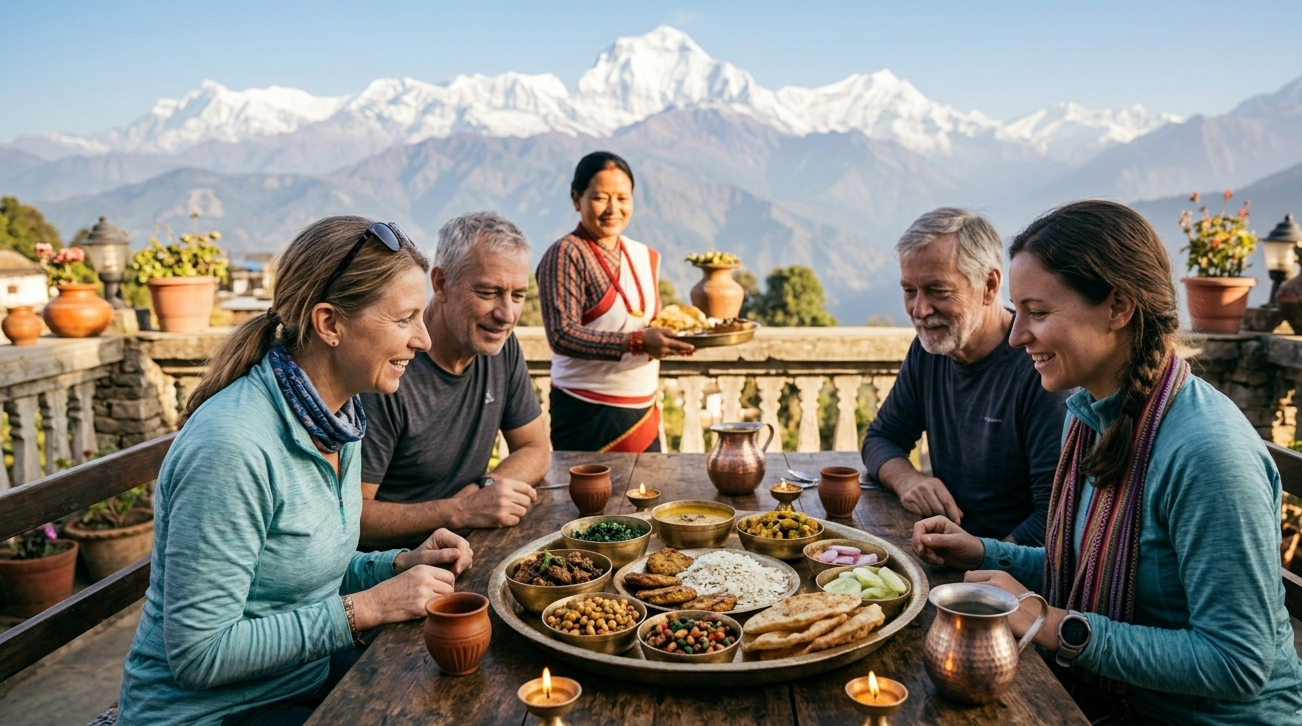
In Kathmandu, restaurants such as Bhojan Griha, Nepali Chulo, Bhanchhaghar, and Banjala have been promoting Nepali art, cuisine, and culture in their own distinct styles. Beyond these establishments, many small eateries in Kathmandu, Bhaktapur, and Patan serve beloved Newari dishes that draw curious visitors.
For a private journey, we often arrange something that sits outside the restaurant category entirely: a private meal in a Newari home in Bhaktapur or Patan, where a family prepares the dishes that their community has made for festivals and ceremonies for generations. This is not a cooking class. It is not a demonstration. It is a meal at someone's table, which is the most direct way Nepal's food culture communicates what it is.
If you are navigating Kathmandu's food scene independently, the simplest rule is this: walk away from the tourist district and eat where the menus are in Nepali. The quality of the food and the authenticity of the experience will increase inversely with the number of foreign language menus visible from the street.
A note on eating with your hands
Food in Nepal is traditionally eaten with the right hand. Eating with hands, especially the right hand, is considered both respectful and practical — it connects the eater to the food in a way that cutlery does not. Festivals and family meals highlight this bond, where sharing food from communal plates with hands is an expression of togetherness.
If you are eating in a local home or a traditional setting, watch what the people around you do and follow their lead. The mixing of rice, dal, and curry with your fingers — turning it into a coherent mouthful — is a skill that takes a little practice and produces a significantly better eating experience than the fork version. Most hosts will be pleased rather than surprised if you try.
The honest summary
Nepal's food rewards the traveler who is willing to eat where locals eat, order what locals order, and approach the table with genuine curiosity rather than caution. It will not always be the most comfortable choice. The plastic stool teahouse in a Bhaktapur alley is less visually appealing than the restaurant with tablecloths and a printed menu. But the bara coming out of that kitchen will be the best thing you eat all week.
This is true of Nepal generally. The most extraordinary experiences are rarely the most obvious ones. Food is no exception.
Nepal as a Local designs private journeys that go beyond the itinerary — including genuine culinary experiences in local homes, markets, and communities that most visitors never access. If you want Nepal from the inside, the conversation begins below.