

How we plan a private Nepal journey: from first message to final day
How we plan a private Nepal journey: from first message to final day
The most common thing people tell us when they first reach out is that they are not entirely sure how to reach out.
They know they want Nepal. They have a rough sense of how long they have. They may have a particular image in their mind — a mountain, a festival, a kind of stillness they are looking for. But the gap between that feeling and an actual journey feels wide, and they are not sure what the first step looks like, or what comes after it.
This piece is the complete answer to that question. Every stage of the process, from the moment you first contact us to the moment you land back home, explained plainly and in order. Nothing left out.
Stage one — the first message
You do not need a complete brief to contact us. You do not need to know your dates, your budget, your preferred destinations, or exactly how many people are in your party. You need only a sense that Nepal is where you want to go and a willingness to have an honest conversation about what that might look like.
The first message can be as simple as: I am thinking about Nepal for next October. I want something private and unhurried. I do not know what that means yet.
That is enough. Everything begins from there.
What we are looking for in a first message — and in the conversation that follows — is not a specification. It is a signal. The kind of traveler you are. The things that matter to you. The experiences that have stayed with you from previous journeys, and the ones that have left you wanting something different. These things tell us more about the right Nepal journey than any list of preferred destinations.
Stage two — the consultation
Within Twenty-Four hours of your first message, we will respond with a proposal for a conversation — a call or a written exchange, whichever you prefer. This consultation is not a sales call. It is a genuine attempt to understand what you are looking for.
The questions we ask during this stage are not about logistics. They are about you.
What does a perfect day of travel feel like? Do you want physical engagement — trekking, altitude, the specific satisfaction of arriving somewhere under your own power — or do you want to move between extraordinary places with minimum friction? How do you feel about silence and solitude versus warmth and community engagement? What is the one thing this journey must contain to feel complete?
We also ask about what you do not want. The experiences that have disappointed you in travel. The things that make a journey feel generic. The conditions under which you stop enjoying yourself. These answers are as important as the positive ones.
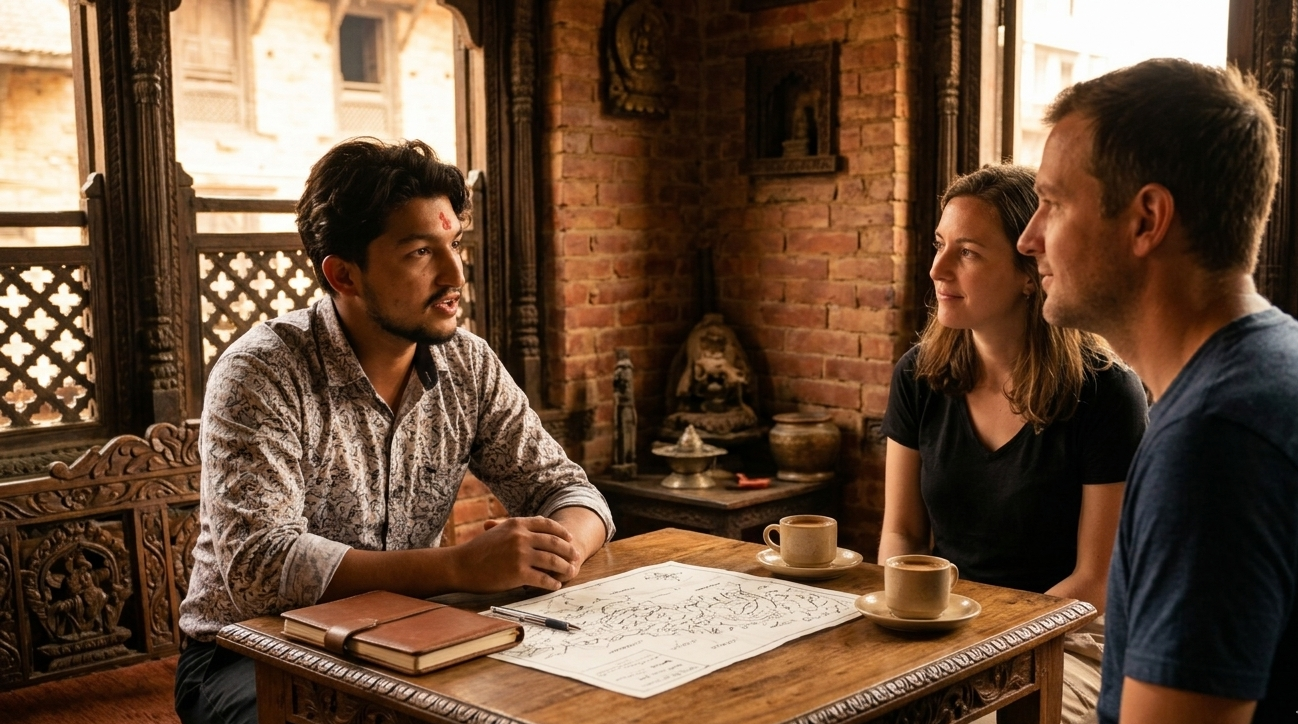
Brief Orientation of the Nepal journey with your private guide
By the end of this conversation, we will have a clear enough picture to begin designing. You will have a clear enough picture of who we are and how we work to know whether you want us to.
Stage three — the first itinerary draft
Within one week of the consultation, we send you two to three drafts.
This is not a package with a name and a price per person. It is a document that begins with a short summary of what we understood you to be looking for — our interpretation of the conversation — and then lays out a proposed journey day by day.
Each day in the draft describes what the experience will feel like as much as what it will contain. Not simply "transfer to Pokhara and check in" but what the drive through the middle hills looks like in the late afternoon, what the lodge you are arriving at feels like, what you are likely to want to do on your first evening there. We write itineraries this way because the feeling of a journey matters as much as its contents, and we want you to be able to read this document and genuinely imagine yourself inside it.
The first draft will also flag decision points — places where two different approaches are possible and where your preference will shape what comes next. Do you want to reach the Annapurna viewpoint on foot over two days, or by helicopter in the morning? Do you want a day in Bhaktapur before flying to Pokhara, or do you want to arrive in Pokhara first and let the culture come later? These are not right or wrong choices. They are choices that reflect who you are as travelers, and we present them plainly so you can make them from a place of understanding rather than uncertainty.
Stage four — refinement
The first drafts are rarely the final itinerary. It is the beginning of a conversation.
Most clients come back with a mix of responses: things that are exactly right, things they want to adjust, and questions about elements they had not considered. This is expected and welcome. The refinement stage is where the journey becomes precisely yours rather than a thoughtful proposal that could suit several different parties.
Common adjustments at this stage include pacing — slowing down a section that feels rushed, adding a rest day in a location that particularly appeals, removing a destination that does not resonate in favour of more depth somewhere else. We also refine accommodation at this stage, presenting specific properties with photographs and descriptions so you can choose between a heritage property in the old city or a boutique lodge above the valley, a mountain lodge with a private balcony or a more secluded property with exclusive use.
We do not have a fixed number of revision rounds. We refine until the itinerary feels completely right. In our experience, this takes two to three exchanges for most parties. Occasionally it takes more, and that is fine. The itinerary we finalise together is the one you will live inside for the entirety of your journey, and it needs to be exactly right.
Stage five — confirmation and logistics
Once the itinerary is agreed upon, we move into confirmation and logistics. This is the stage that is entirely invisible to you — by design.
We confirm all accommodation, private vehicles, guide assignments, permit applications, and any special access arrangements. Restaurants for private dinners are reserved. Helicopter bookings, where applicable, are made with the flexibility built in to accommodate weather changes. Local contacts are briefed. Contingency plans are prepared for every section of the journey where weather or conditions might require adaptation.
You receive a single, clean final document: your confirmed itinerary with every detail in place, every contact listed, and every element confirmed. There are no loose ends in this document. If something cannot be confirmed with complete certainty — a permit timeline, a specific access arrangement that depends on local conditions — we tell you that explicitly and explain the contingency.
We also prepare a private briefing at this stage covering everything you need to know before you arrive: what to pack for each section of the journey, altitude considerations and how to manage them, a cultural briefing for the communities you will be visiting, and any practical details relevant to your specific party. This document is written specifically for you — not a generic Nepal travel guide, but a briefing based on your itinerary, your party's profile, and our knowledge of the specific places you will be moving through.
Stage six — arrival
Your guide meets you at Tribhuvan International Airport in Kathmandu. This is not a driver holding a sign. It is the person who has been briefed on every aspect of your journey and who will be your primary point of contact for its entirety.
The first transfer from the airport is when the journey actually begins. Your guide will use this time — depending on your energy level after a long flight — either to give you a first sense of Kathmandu through the window as you move through the city, or simply to let you decompress in quiet. They read the room. They have been doing this for long enough to know the difference between a party that wants to talk and a party that needs silence.
Your first evening is always deliberately undemanding. Good food. A comfortable space. The beginning of acclimatisation to the altitude, the food, the particular quality of light and noise and smell that announces you are somewhere genuinely different. We do not put anything important on the first evening. We save the important things for when you are ready.
Stage seven — the journey itself
This is the part that is hardest to describe in a planning document, because the best moments of a Nepal journey are the ones that cannot be planned.
What we can describe is the structure that makes those moments possible.
Every day has a shape — a sense of what the morning will contain, what the afternoon holds, and what the evening looks like. But within that shape, there is deliberate space. Space for a conversation to continue longer than expected. Space for a route to change because your guide noticed something worth seeing that is not in any itinerary. Space for you to decide, on the morning of a planned activity, that you would rather sit with your tea and look at the mountain for another hour.
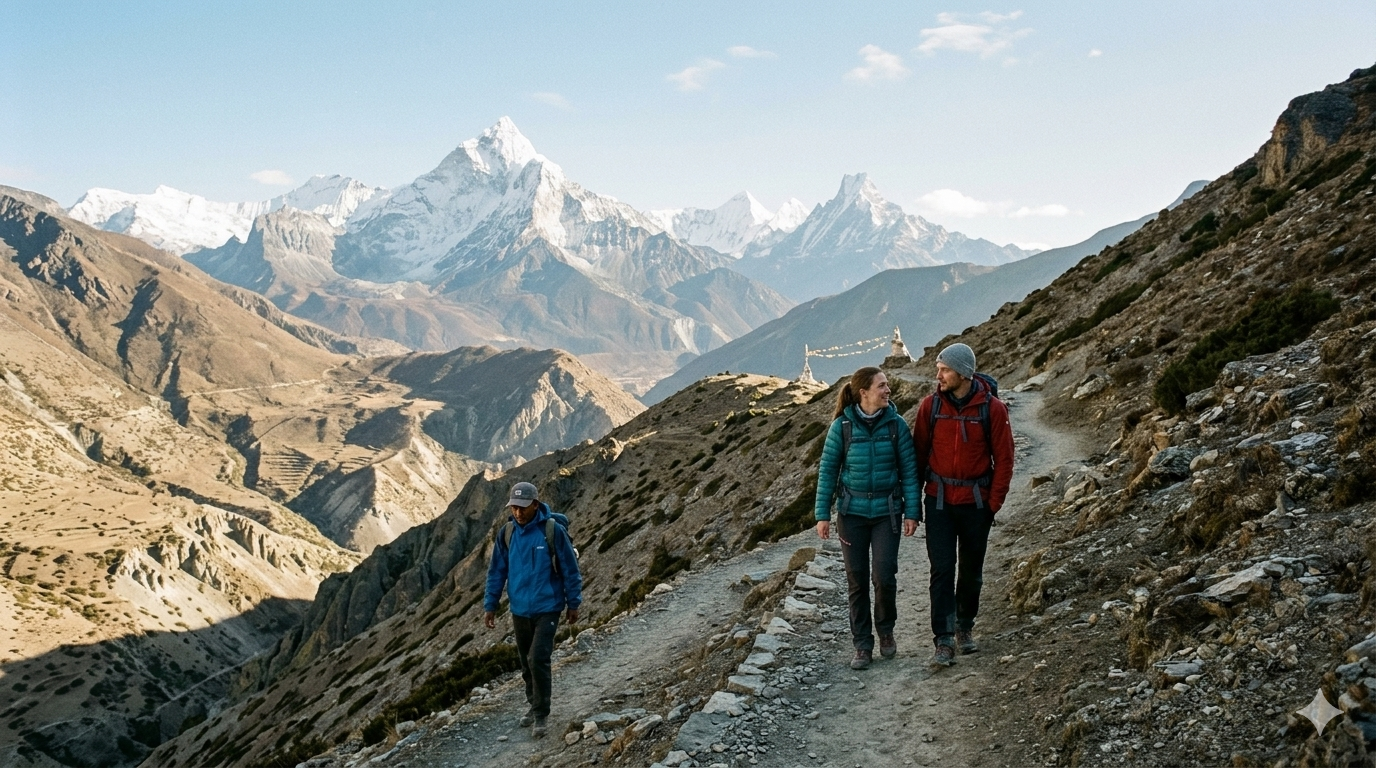
Your Moments to live with each other in the scerene himalayan trails
Your guide is not a tour conductor moving you through a schedule. They are a local expert whose job is to pay close attention to what your party needs on any given day and to shape the experience accordingly. If you are more energised than expected on a morning that was planned to be restful, they know what to offer. If you are more tired than anticipated after a long day at altitude, they know what to remove from the following morning. This kind of attentiveness is not a feature you can list in an itinerary. It is the product of experience, genuine local knowledge, and the freedom that comes from working with one party at a time.
We are also available throughout the journey. Not intrusively — you will not receive check-in messages from us unless something requires communication. But if something needs to change, if a question arises, if a decision needs to be made that goes beyond your guide's brief, we are reachable and we respond quickly.
Stage eight — departure and beyond
The final morning of a Nepal journey has a particular quality that we have observed consistently across many parties over many years. There is a reluctance that is not quite sadness — more like the feeling of not being quite finished with something, of wanting a little more time.
We take this as a good sign.
Your guide accompanies you to the airport on the final day. The handover is clean and complete — no logistics outstanding, nothing uncertain. You leave with everything confirmed and nothing requiring your attention.
What happens after departure is less formal but not less real. In the weeks and sometimes months that follow, we often hear from guests. A photograph they wanted to share. A question about something they saw that they have been thinking about. A message saying that they have decided to come back — different region, different season, a different kind of journey.
These conversations are some of the best parts of running this business. They are also, in a way, the proof that what we built together over the course of a journey was worth building.
What this process is not
It is not a package with a fixed price and a standard route.
It is not a booking form followed by a confirmation email followed by a driver at the airport.
It is not fast. The design of a private Nepal journey takes time — the consultation, the drafts, the refinement. For parties with complex requirements or long journeys, the process from first message to confirmed itinerary can take three to four weeks. This is not a limitation. It is what genuine personalisation requires.
And it is not the same journey twice. Every party we work with receives a journey that has been designed from scratch around who they are and what they are looking for. The landscape is the same. The experience is entirely theirs.
Where to begin
If you have read this far, you are probably ready to send the first message.
You do not need to know everything yet. You need only to start the conversation.
Nepal as a Local designs exclusively private Himalayan journeys — one party at a time, from first message to final day. If you are ready to begin, we are ready to listen.