

Is Nepal good for luxury travel? A definitive 2026 guide
Is Nepal good for luxury travel?
Let's answer the question directly.
Yes. Nepal is exceptionally good for luxury travel in 2026 — provided you understand what kind of luxury Nepal offers, and have the right local expertise to access it.
That second condition is not a sales line. It is the honest difference between a journey that transforms you and one that merely transports you.
Here is what the high-end travel landscape in Nepal actually looks like in 2026, and how to navigate it properly.
Why the question still gets asked
Nepal's global reputation was built over decades of a very particular kind of travel: rugged mountaineering, teahouse trekking, and the counter-cultural backpacker trail through Kathmandu and Pokhara. That reputation is not wrong — it describes something real and genuinely extraordinary about this country.
But it describes a version of Nepal that exists alongside a very different one, which the world has been slower to notice.
Away from the crowded trekking thoroughfares, a world-class private travel infrastructure has been quietly and carefully built. Heritage mansions in the Kathmandu Valley have been restored by master craftspeople into boutique hotels of genuine distinction. Mountain lodges have been constructed at altitude with the precision of architectural sanctuaries — heated, intimate, and positioned in landscapes that no resort in the Maldives or the Alps can replicate. Private aviation has compressed the country's extraordinary geography into a single morning.
The question is not whether Nepal has luxury. The question is whether you know where to find it — and whether the person guiding your journey knows how to make it available to you.
What luxury actually means in Nepal
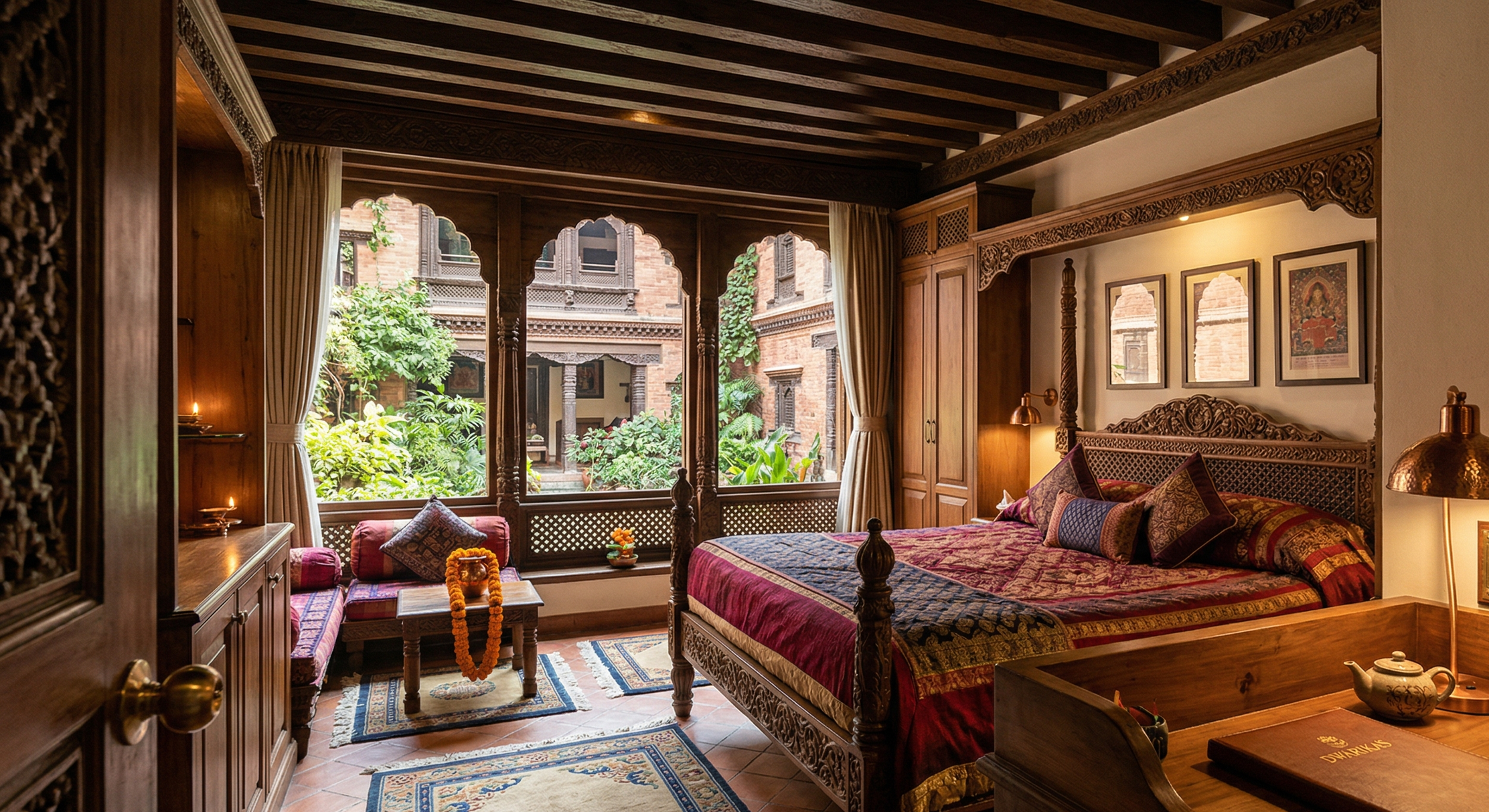
Boutique stays in Kathmandu
Nepal does not offer the standardised, mass-market luxury of an all-inclusive Caribbean resort. If that is your reference point, Nepal will not meet your expectations — and nor should it try. What Nepal offers is something rarer, and by the measure of what the world's most sophisticated travelers are seeking in 2026, considerably more valuable.
The biggest shift in luxury travel right now is a move away from acquisitive tourism and toward purpose-driven experiences. Today's luxury traveler isn't asking for more — they're asking for better: better impact, better alignment with their values, and smarter use of their time, money, and emotional bandwidth. OutThere
Nepal's luxury is defined by three things that no standardised resort can manufacture: boutique exclusivity, genuine privacy, and access that comes from real local relationships rather than a concierge department. Understanding this distinction is the foundation of planning a high-end Nepal journey that actually delivers.
The accommodation: what is available in 2026
Nepal's luxury accommodation landscape in 2026 is more sophisticated than most international travelers realise. Here are the categories that define a high-end stay.
Heritage properties in the Kathmandu Valley
Dwarika's Hotel in Kathmandu's Battisputali neighbourhood encapsulates the Nepalese arts and crafts era — its red brick facade featuring elaborate carvings, timber-beamed ceilings, antique four-poster beds, and terracotta tiled floors. Guests can book Ayurvedic treatments in the spa, take yoga classes, and dine across three restaurants including one offering a 22-course Nepalese menu. The Luxury Editor This is the standard of heritage hospitality that defines the Kathmandu Valley's best properties — not a hotel that happens to be old, but a living archive of Nepalese craftsmanship that functions as exceptional accommodation.
Beyond Dwarika's, the restored palaces of Patan and Bhaktapur offer smaller, more intimate alternatives — properties of eight to twenty rooms where your party may have exclusive use of an entire courtyard property, waking to the sound of the city's ancient rhythms rather than a hotel lobby.
Mountain lodges at altitude
The finest lodges along the Annapurna and Everest approaches have been designed with the seriousness of the landscape they inhabit. Tiger Mountain Lodge above Pokhara, acclaimed for its commitment to eco-tourism, provides the perfect base from which to experience the Himalayan landscape without compromising on quality. The Pavilions Himalayas offers a luxurious eco-sensitive retreat in the Pokhara region, balancing exploration and relaxation in a setting of exceptional natural beauty. Scott Dunn
At their best, these lodges offer heated rooms with private balconies facing 8,000-metre peaks, gourmet menus built from local mountain ingredients, and a quality of silence that no city hotel can replicate. They are not roughing it with better mattresses — they are genuinely world-class hospitality in one of the world's most extraordinary settings.
Exclusive private use properties
For parties seeking complete privacy — families, small leadership groups, couples who want no other guests in their immediate environment — Nepal offers a category of property that receives almost no international coverage: entirely private-use heritage estates and lodge compounds, available exclusively to a single party for the duration of their stay. These are the properties we work with most closely, and they represent the finest private accommodation in the country.
The three pillars of a high-end Nepal journey
1. Private aviation: turning geography into an asset
Nepal's topography is its greatest asset and, without the right approach, its greatest logistical challenge. The distances between extraordinary destinations — Kathmandu, the Mustang plateau, the Everest approaches, the Annapurna region — are significant when navigated by road. By private helicopter, they become a morning.
A high-end Nepal itinerary in 2026 uses private aviation not as an extravagance but as a tool for maximising what is possible within the time your party has available. Breakfast in Kathmandu's medieval Bhaktapur valley. A private landing in Upper Mustang before the rest of the world is awake. Sundowners on an Annapurna ridge reached in twenty minutes rather than three days.
This is how a ten-day Nepal journey delivers experiences that a standard itinerary could not achieve in three weeks.
2. Guide expertise: the real luxury infrastructure
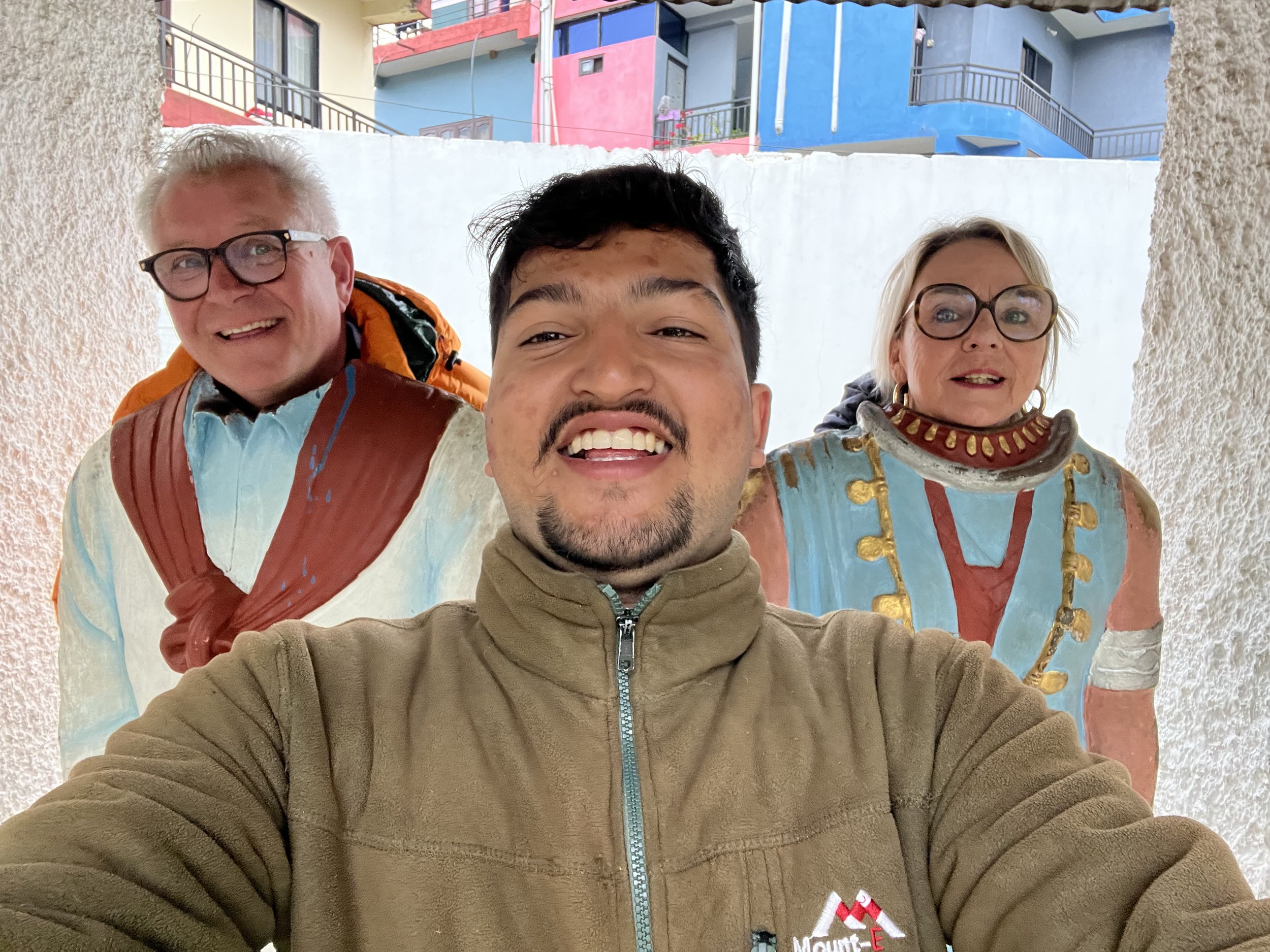
Local cultural interactions and fun time with Ashwin
In most destinations, a guide is a logistics function. In Nepal, a guide is the journey.
The cultural and geographical complexity of Nepal — the layers of Buddhist, Hindu, Newari, Tibetan, and Sherpa culture, the altitude management, the permit navigation, the community relationships that open doors no booking platform can access — means that the quality of your guide directly determines the quality of your experience.
Access, rather than ownership, has become the new currency of luxury in 2026. The most discerning travelers are seeking entry to destinations and experiences unavailable to the general public — and this requires operators with genuine local expertise, not curated packages built from a distance. Elite Traveler
Our guides are not generalists. They are specialists in specific regions, specific cultural contexts, and specific kinds of traveler. They are the reason a monastery door opens. The reason a conversation with a lama happens. The reason your journey has moments that are not on any itinerary — because someone who knows this country understood when to create space for them.
3. Blank-canvas itinerary design: the only approach worth taking
The phrase "luxury Nepal vacation package" is, in our view, a contradiction in terms. A package implies something pre-assembled — designed for a category of traveler rather than for you specifically.
Every journey we design in 2026 begins with a single blank document and a conversation about what you are actually looking for. Not which destinations, initially — but what you want to feel, what you want to understand differently, what kind of experience would make this the journey you remember most.
From that conversation, everything follows: the routing, the accommodation selection, the pacing, the balance between structured experiences and unstructured space, the specific moments of access that only local expertise can provide.
Personalization is the top driver of loyalty among luxury clients in 2026. Exclusive, personalized moments have become the new benchmark of status and value — and for today's luxury traveler, true prestige comes from feeling completely understood. Expedia Group
This is the standard we hold ourselves to. Not the most expensive itinerary, but the most precisely right one for the person in front of us.
The honest answer to the question
Nepal is good for luxury travel in 2026 in the way that a Stradivarius is good for music — it requires a skilled hand to reveal what it is capable of. In the wrong hands, it produces something ordinary. In the right ones, it produces something that stays with you for the rest of your life.
The country has the accommodation. It has the landscapes. It has the culture, the history, the spiritual depth, and the natural scale that no destination that has been optimised for mass tourism can replicate. What it requires is a partner who understands it completely — not from a brochure, but from a lifetime of being here.
That is the local advantage. And in Nepal, it is everything.
Nepal as a Local designs exclusively private journeys for the world's most discerning travelers — one party at a time, with no compromises on access, pace, or experience. If you are ready to discover what Nepal offers at its finest, the conversation begins below.