

Tihar: Nepal's festival of lights through local eyes
There is a moment on the third evening of Tihar — Laxmi Puja — that I have watched happen many times and have never once seen leave a visitor unchanged.
The sun has gone down over the Kathmandu Valley. Every house, in every direction, is lit with rows of small clay oil lamps — diyos — placed along windowsills, doorways, rooftops, and walls. The effect is not dramatic in the way a fireworks display is dramatic. It is quieter than that. More intimate. The city does not explode into light; it breathes it, gently and from every surface at once, until the darkness between buildings fills with something warm and old and entirely unlike anything most visitors have encountered before.
This is Tihar. And almost nobody outside Nepal knows what it really is.
The festival most travelers have never heard of
Tihar is Nepal's second greatest festival, after Dashain. It is a five-day Hindu festival of lights celebrated across Nepal — known in different communities as Deepawali, Yamapanchak, or Swanti — observed each year in October or November according to the Nepali lunar calendar.
Most international travelers are familiar with Diwali, the Indian festival of lights that shares some of Tihar's traditions. The two are related but distinct. Diwali is celebrated across most of South Asia in various forms. Tihar is Nepal's version — and it has qualities that exist nowhere else.
The most unusual of these: five of its days are dedicated not to gods or to humans, but to animals.
The five days — what actually happens
Tihar 2026 will be celebrated in Nepal from November 7 to November 11. Each of the five days carries its own rituals, its own meaning, and its own particular atmosphere. Here is what they look like from the inside.
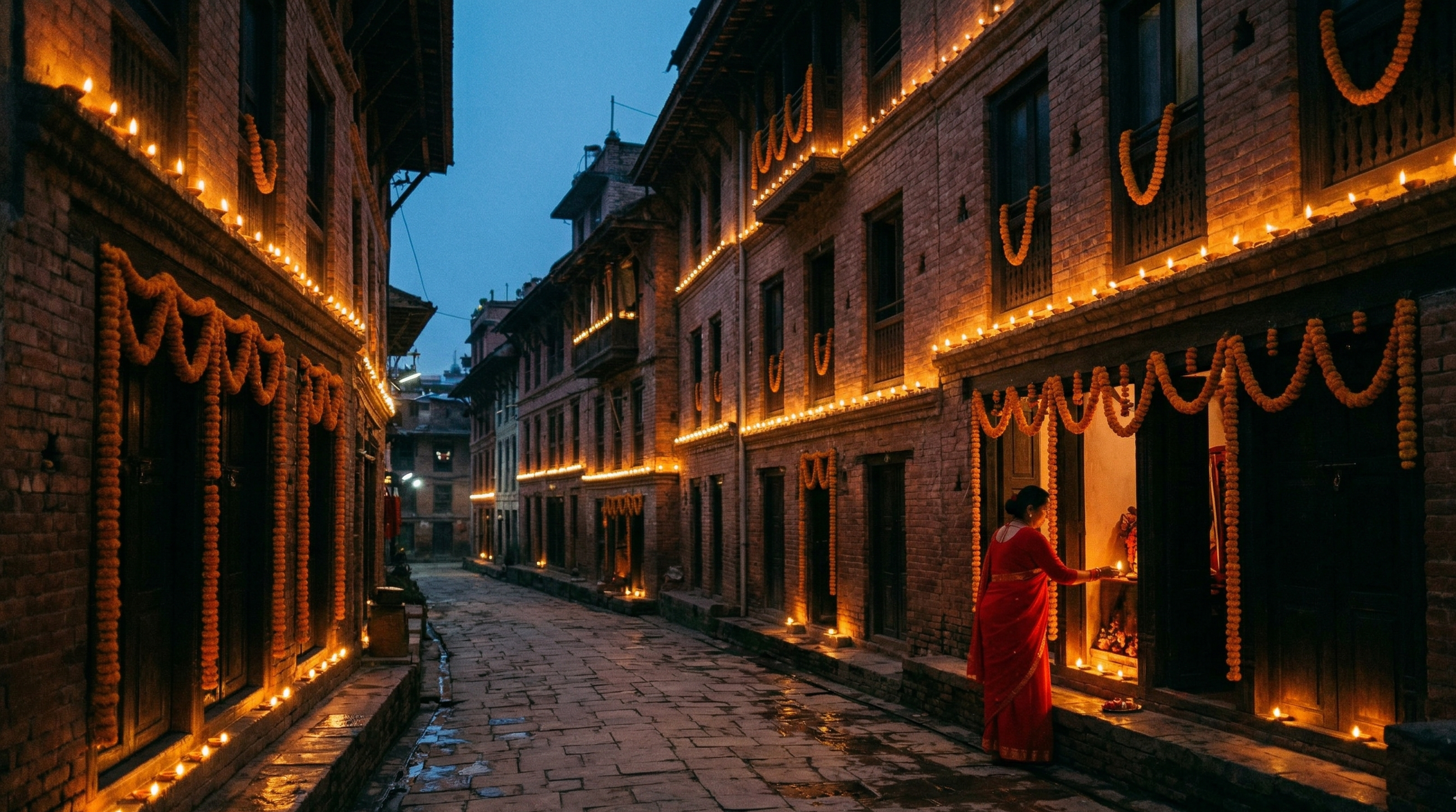
Streets of Kathmandu lit up with Diyo lights welcoming the goddesses Laxmi for wealth and prosperity
Day one — Kaag Tihar: the day of the crow
On the first day, crows and ravens are worshipped and fed sweet foods and delicacies left for them to find on rooftops and in courtyards before sunrise. The caw of the gathering crows is significant to Hindus — feeding them is thought to prevent calamity in the coming year.
I have always found this the most quietly profound of the five days. The idea that a festival of light begins not with pageantry but with a small, early morning offering placed on a rooftop for a bird — that the first act of this celebration is gratitude toward a creature most cultures consider an omen of misfortune — says something important about how Nepal understands the world.
The crows always come. They arrive before the city has fully woken. If you are staying somewhere with a rooftop view over Kathmandu on this morning and you are awake before sunrise, you will understand why this day matters.
Day two — Kukur Tihar: the day of the dog
On the second day, dogs are worshipped as messengers of the god of death, Yama. You will see dogs wearing flower garlands and bearing red or white tika on their foreheads — honoured, garlanded, and fed treats by the families they live with and by strangers on the street.
This is the day that tends to surprise visitors most completely. Nepal does not have the same relationship with dogs as many Western cultures — street dogs are common, and the relationship between humans and dogs here is often more complex than sentimental. Watching that relationship transformed for a day — every dog in the country garlanded and blessed and offered food with genuine reverence — is one of the more disorienting and moving things you can witness in this country.
Day three — Laxmi Puja: the evening that changes everything
The morning of day three begins with the worship of cows — garlanded and fed, honoured for their role in Nepali agricultural life. But it is the evening that defines Tihar for most visitors.
Laxmi, the goddess of wealth, is welcomed into homes that have been cleaned and decorated. Diyos are placed along every doorway and windowsill — the belief being that the goddess will not visit dark homes. A special puja is offered in the evening, wishing for wealth, prosperity, and good health. Young girls go around the neighbourhood singing and dancing in a tradition called bhailo.
A colourful rangoli — intricate patterns made from coloured rice, flour, or flower petals — is created in the front yard of each home. A small footprint made from flour and red powder is drawn from the entrance gate to the main altar, symbolising the goddess's arrival.
This day is less visible to visitors than the others — it is more intimate, more internal. But if you are staying in a heritage property in the Kathmandu Valley with genuine Newar connections, you may be invited to witness or participate in elements of the Mha Puja. This is not something that happens on a tour. It happens because someone trusts you enough to include you.
Day five — Bhai Tika: the ceremony of siblings
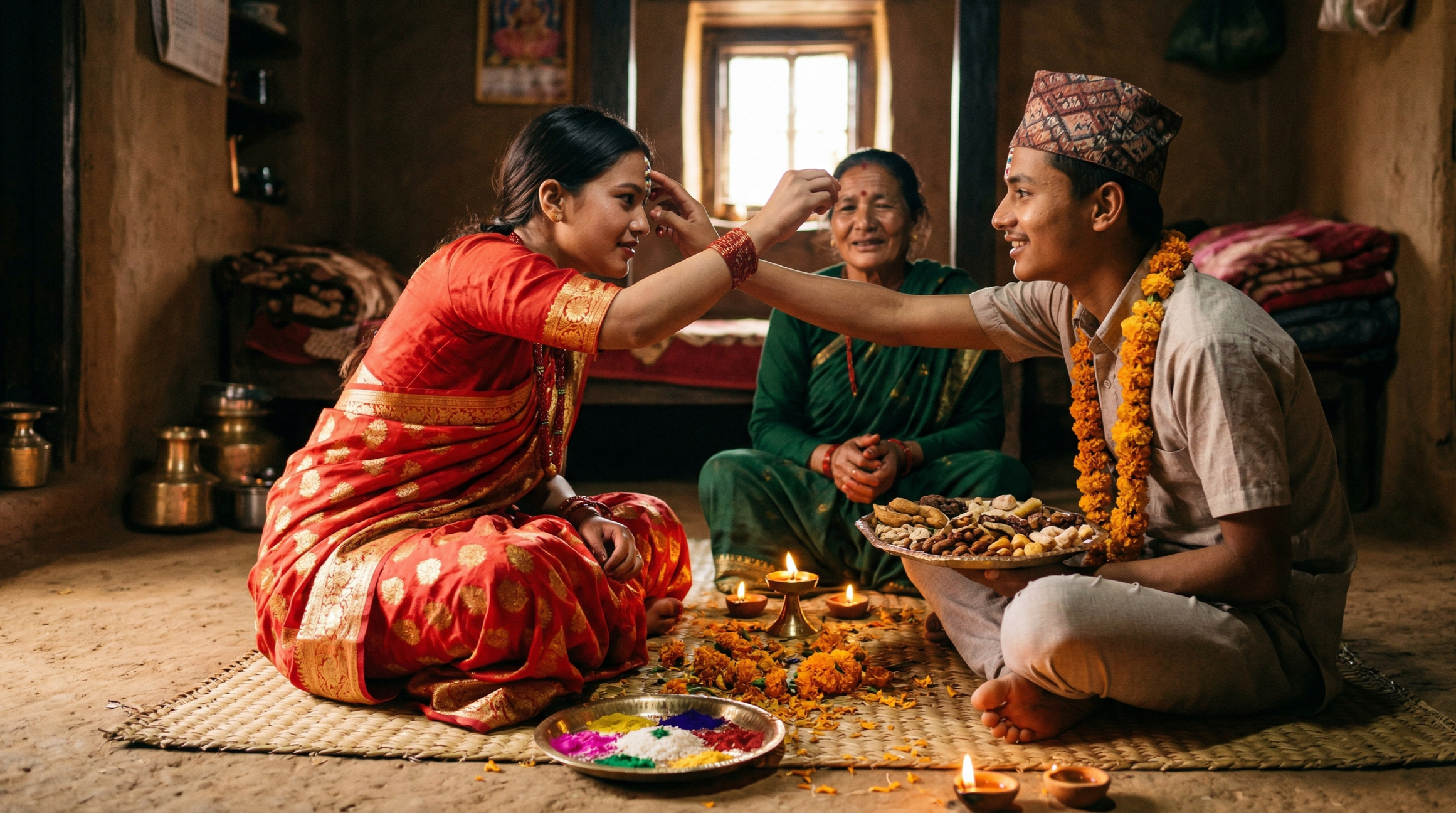
A nepalese household celebrating Tihar Bhaitika among brother and sister blessing for long life and good health
The fifth and final day of Tihar is Bhai Tika — the day when sisters place tika on their brothers' foreheads to secure for them a long and happy life. Sisters encircle brothers and apply the seven-coloured Saptarangi tika, exchanging garlands and gifts in a ceremony rooted in a story about a sister who bargained with the god of death himself to protect her brother's life.
The legend matters here. Yamuna's brother was mortally ill, and Yama — the god of death — came to collect his soul. Yamuna pleaded for time. She began a puja so elaborate and so sincere that Yama was moved. He agreed that her brother would be protected as long as the tika on his forehead remained, the garlands were fresh, and the oil she had applied did not dry. The ceremony of Bhai Tika is, at its root, a ritual of love powerful enough to negotiate with death.
Watching this ceremony — even as an outsider, even at a respectful distance — is one of the more affecting experiences Nepal offers. It is not performed for visitors. It happens in every home in the country simultaneously, on the same morning, in the same quiet and determined way it has happened for centuries.
What Tihar feels like from the inside
I want to be honest about something that travel writing often avoids.
Tihar, experienced as a tourist passing through, is beautiful. The lights are extraordinary. The markets are alive with marigolds and sweets and the particular chaos of a city in celebration. The photographs you take will be among the best of your life.
But Tihar experienced as a guest — welcomed into a home, invited to place a diyo, sitting at a family table on Bhai Tika morning, understanding what each day means rather than simply witnessing what it looks like — is something of a different order entirely.
The Tihar festival shows Nepal's most authentic culture, tradition, and beliefs. Being part of this festival means experiencing the unique and traditional culture up close — the view of houses bathed in twinkling lamps and decorated with marigolds, dancing along with neighbours singing Deusi-Bhailo in the streets, and tasting festival foods. You might also receive an invitation from friendly locals to their homes for blessings and feasts.
This second kind of experience does not happen by accident. It happens because of relationships — because someone in your party has a local guide who has been attending this festival all their life, who knows which family in Bhaktapur will welcome you to their courtyard, who understands the rhythms of each day well enough to put you in exactly the right place at exactly the right moment.
This is what we design for. Not a Tihar tour — a Tihar experience.
Planning around Tihar 2026
Tihar 2026 will be celebrated in Nepal from November 7 to November 11. This places it in the heart of Nepal's finest travel season — clear skies, comfortable temperatures, and the extraordinary light that makes the Kathmandu Valley's medieval architecture look like it was built specifically to be photographed at this time of year.
A journey timed around Tihar works beautifully combined with a private trek in the Annapurna or Everest regions before the festival, allowing you to arrive in Kathmandu for the final three days — Laxmi Puja, Mha Puja, and Bhai Tika — when the celebrations are at their deepest.
For families traveling with children, Tihar is one of the finest cultural experiences Nepal offers — accessible, joyful, and full of the kind of sensory richness that stays with young people for decades.
We track the exact dates of Tihar and all of Nepal's major festivals each year as part of our journey planning. If you are considering Nepal in November 2026, the conversation about timing should start now.
Nepal as a Local designs exclusively private journeys timed around Nepal's most extraordinary cultural moments — one party at a time, with access that only local expertise makes possible. If Tihar 2026 is something you want to experience from the inside, begin the conversation below.