

The images that do not exist yet: why elite photographers are coming to Nepal
There is a moment every serious photographer eventually reaches.
It arrives quietly, usually in the editing room. You are working through a shoot from somewhere celebrated — a destination you planned for months, traveled far to reach, woke at four in the morning to photograph in the right light. The images are technically accomplished. The composition is considered. The light, on the morning you were there, was genuinely extraordinary.
And then you open a stock library, or a photography community, or the portfolio of another photographer you respect — and you see your image. Not yours, exactly. But an image indistinguishable from yours, made from the same position, in the same quality of light, by someone who stood exactly where you stood in the months before you arrived.
This is the moment that changes what a photographer looks for.
Not: where is the most beautiful place?
But: where are the images that do not yet exist?
The problem with the world's celebrated landscapes
The world's most photographed locations are most photographed for a reason. They are extraordinary. The light on the Dolomites at golden hour is genuinely unlike anything available in the flatlands. The lavender fields of Provence in June are not overrated. Kyoto in the moment the cherry blossoms reach their peak is as beautiful as the photographs suggest.
But beauty and photographic opportunity are not the same thing anymore. Travel photography aims to convey the essence and magnificence of a place — its history and culture — to viewers who may not have had the opportunity to experience it firsthand. The most powerful travel images transport the viewer somewhere genuinely new. Impact Wealth
The emphasis there is on new. When a location has been photographed by thousands of skilled professionals in every season, in every light, from every angle, the images it produces — however technically accomplished — no longer transport anyone to somewhere genuinely new. They confirm what the viewer already knows.
The most compelling travel photography work in 2026 comes from destinations that are not on most photographers' radars — places whose visual story has not yet been comprehensively told, whose landscapes and cultures remain visually underdocumented, where the photographer's presence is an act of genuine discovery rather than competent repetition. The Luxury Editor
Nepal has a category of landscape and culture that meets this description precisely. Not the Nepal that appears in stock libraries. The Nepal that has barely been reached by a tripod.
What Nepal's undiscovered regions actually are
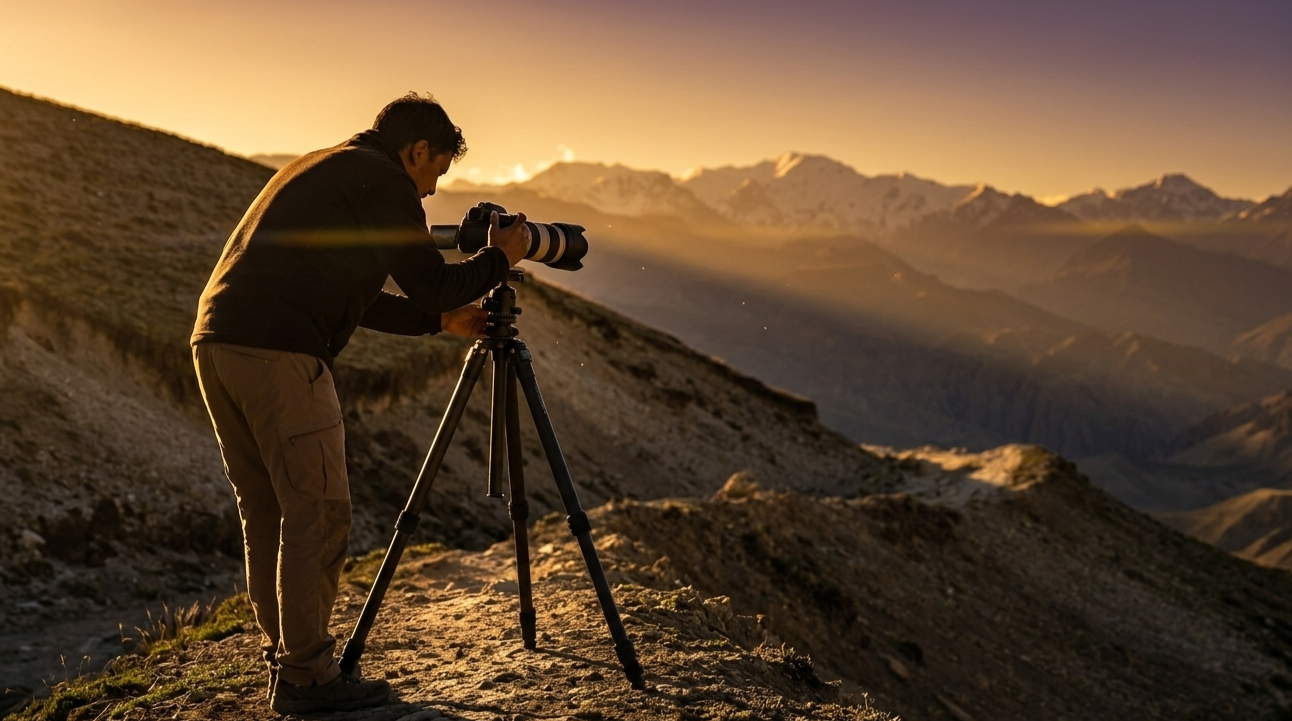
Upper Mustang Photo Excursion
Nepal is the most topographically dramatic country on earth. Eight of the world's ten highest peaks rise within its borders. It contains more vertical relief — the distance between its lowest and highest points — than any comparable land area on the planet. Its cultures span Buddhist, Hindu, Newari, Tibetan, Sherpa, Gurung, Magar, Rai, and Limbu traditions, each with distinct visual languages, ceremonial practices, and architectural heritage.
The version of Nepal that appears in most photography — Everest Base Camp, Poon Hill at sunrise, Boudhanath, the prayer flags of the Annapurna Circuit — is real and genuinely beautiful. It is also the version that tens of thousands of photographers visit every trekking season, producing images that have established a visual vocabulary so comprehensive that working within it has become an act of reference rather than discovery.
The Nepal we take elite photographers to exists outside that vocabulary entirely.
Beyond Nepal's popular trekking corridors lie regions of extraordinary wildness — high-altitude environments of hanging glaciers, serene Hidden Valleys at over 5,000 metres, ancient forest giving way to ice field, and trans-Himalayan landscapes where the colours, the geological formations, and the quality of light bear no resemblance to the Nepal of the standard travel portfolio. Visa
These are not simply remote versions of familiar landscapes. They are visually distinct in the most fundamental sense — different rock, different light, different sky colour at altitude, different communities with different faces and different ceremonies and different relationships to the mountains they have lived beside for centuries.
The images that come from these places do not compete with the images that already exist from Nepal. They occupy an entirely separate visual territory.
The light that changes what is possible
Every photographer who has worked at high altitude in Nepal's less-visited regions describes the light in similar terms: sharper, more saturated, more extreme in its contrasts, and more brief in its optimal moments than anything available at lower elevations or in more accessible terrain.
At 4,700 metres and above, the atmosphere is thin enough that the pre-dawn alpenglow on snow and ice has a quality that does not exist at sea level. The shadows are deeper. The highlights are more intense. The window between flat pre-dawn grey and the harsh mid-morning overhead sun is narrower — perhaps twenty minutes in which the light on a Himalayan face does something that no photograph taken at any other time of day can replicate.
The photographers who find this light and learn to work within it produce images that are immediately, unmistakably different from everything in the standard Himalayan archive. Not because they are more skilled — though they are often exceptional — but because the raw material they are working with is categorically different from what is available on the standard routes.
The most compelling landscape photography comes from places where the photographer has genuine creative solitude — where they are not competing for position with other photographers, where the location has not yet defined the optimal angle, and where the act of composing an image requires original thought rather than the execution of a shot that has been made before.
In Nepal's undiscovered high-altitude regions, this is the condition that awaits. The viewpoint that no other photographer has established. The approach to the face that no standard itinerary includes. The pre-dawn position on the moraine that reveals a relationship between peaks that the standard route never shows.
These are not accidents. They are the result of local knowledge applied to photographic purpose — and they are what defines every expedition we design.
The cultural subjects that have not been told
Landscape is only one dimension of what Nepal's undiscovered regions offer the serious photographer. The human dimension is equally extraordinary — and in some ways more urgent.
Nepal's remote communities — the Loba people of the ancient kingdom beyond the Himalayan rain shadow, the Tibetan Buddhist villages of the high northern valleys, the Magar and Gurung communities of the less-visited western ranges, the Sherpa and Rai villages of the far eastern border region — practise cultural traditions that are alive, intact, and visually extraordinary. Their ceremonies are not staged. Their faces carry the specific character of people who have lived in relationship with these mountains for generations. Their architecture — the gompa walls painted in the 8th century, the chortens built along routes that were trading paths before they were trekking trails — has been documented photographically in almost no depth.
The most powerful travel photography tells a story through images that transport the viewer to another place — immersing them in the unique experiences and perspectives of a community or culture that they would not otherwise encounter. Impact Wealth
The communities in Nepal's undiscovered valleys are, in 2026, among the most visually uncharted on earth. Not because they are inaccessible in principle — but because the combination of local relationships, permit navigation, expedition-level logistics, and genuine cultural respect required to photograph them properly has limited serious photographic access to a handful of people over many decades.
This is what local expertise changes. Not just the logistics — the relationships. The monastery door that opens because the person accompanying you has maintained a connection with that community for years. The family that agrees to be photographed during a festival preparation because they know and trust the person who asked. The ceremony that proceeds without the self-consciousness that the presence of an unknown outsider with a camera would otherwise produce.
The portraits that result from this kind of access are not portraits of people performing for a camera. They are portraits of people who have forgotten the camera is there. This distinction is visible in every pixel of the image — and it is the difference between a technically accomplished travel portrait and a photograph that stops a viewer completely.
Why these regions specifically
The Himalayan regions we take elite photographers to have been chosen for a specific set of photographic qualities that exist nowhere in Nepal's more visited corridors.
The Hidden Valley above the French Pass sits at over 5,200 metres in a natural basin enclosed by peaks exceeding 7,000 metres. It is a serene, isolated expanse of barren, high-altitude terrain whose stillness, combined with the surrounding towering peaks and hanging glaciers, creates a photographic environment unlike anything available on Nepal's standard trekking routes. Visa The images that exist publicly from this location are sparse — taken by expedition teams rather than dedicated photographers, representing a tiny fraction of what the landscape offers across different seasons and lighting conditions.
The far western Himalayan ranges contain Nepal's most remote 7,000-metre peak — so rarely visited that its surrounding valleys have been traversed by expedition teams only a handful of times. The villages in this far western region exist outside the changes that development and tourism have brought to the rest of Nepal — authentic, intact, their culture shaped by centuries of geographic isolation. HunterMoss The visual archive of this region is genuinely sparse. The images that a serious photographer could make here do not compete with existing work because the existing work is almost non-existent.
The restricted eastern border region contains the third-highest mountain on earth, approached through terrain so remote that the visual documentation of the peak — despite its scale — is a fraction of what exists for Everest. The journey unfolds through three distinct vegetation zones, cultures, and landscapes — from subtropical jungle through rhododendron and oak forest to glaciated high terrain, with communities of Sherpa, Rai, and Limbu culture whose traditions have evolved separately from the more photographically explored communities of the Everest and Annapurna regions. OutThere
The hidden northern valley beside the eighth-highest mountain contains monastery walls painted in the 8th century CE, visited by fewer serious photographers per year than almost any accessible cultural site in Asia. The ceremonies that take place here — specific to this community's particular form of Tibetan Buddhism, shaped by centuries of geographic isolation — have been documented by almost no dedicated photographer and whose visual story remains almost entirely untold.
These are not four obscure consolation destinations for photographers who could not get into the popular locations. They are, by every measure that matters to a serious visual storyteller — light quality, cultural depth, photographic scarcity, and the possibility of genuine discovery — among the finest photography destinations in the world.
The expedition structure: built around your vision
Every photography expedition we design begins not with a route but with a conversation about your work.
Not your fitness level. Not your preferred dates. Your work — the images you are trying to make, the gaps in your archive, the visual territory you have not yet covered, and the specific photographic qualities you are looking for in a new landscape.
From that conversation, we determine which region — or which combination of regions — serves your vision most precisely. We then design the itinerary entirely around light, not logistics.
The day begins when the pre-dawn conditions call for it. If the light at a specific location is worth a four-hour approach in the dark, the day begins four hours before dawn. If the weather creates an unexpected opportunity on a planned rest day, the rest day changes. If a location rewards two days rather than one — because the morning and evening light are different enough to produce an entirely different set of images — the itinerary gives you two days.
There is no group whose pace competes with yours. No other photographer whose preferred subjects pull the day in a direction that serves them but not you. No shared schedule built around an average party rather than your specific goals. One party, one set of photographic intentions, one undivided commitment from the local expertise around you.
This is not a premium version of a group photography tour. It is categorically different in the same way that a commissioned portrait session is different from a stock shoot — the work is directed toward a specific vision rather than toward acceptable results for an undifferentiated audience.
What the images look like
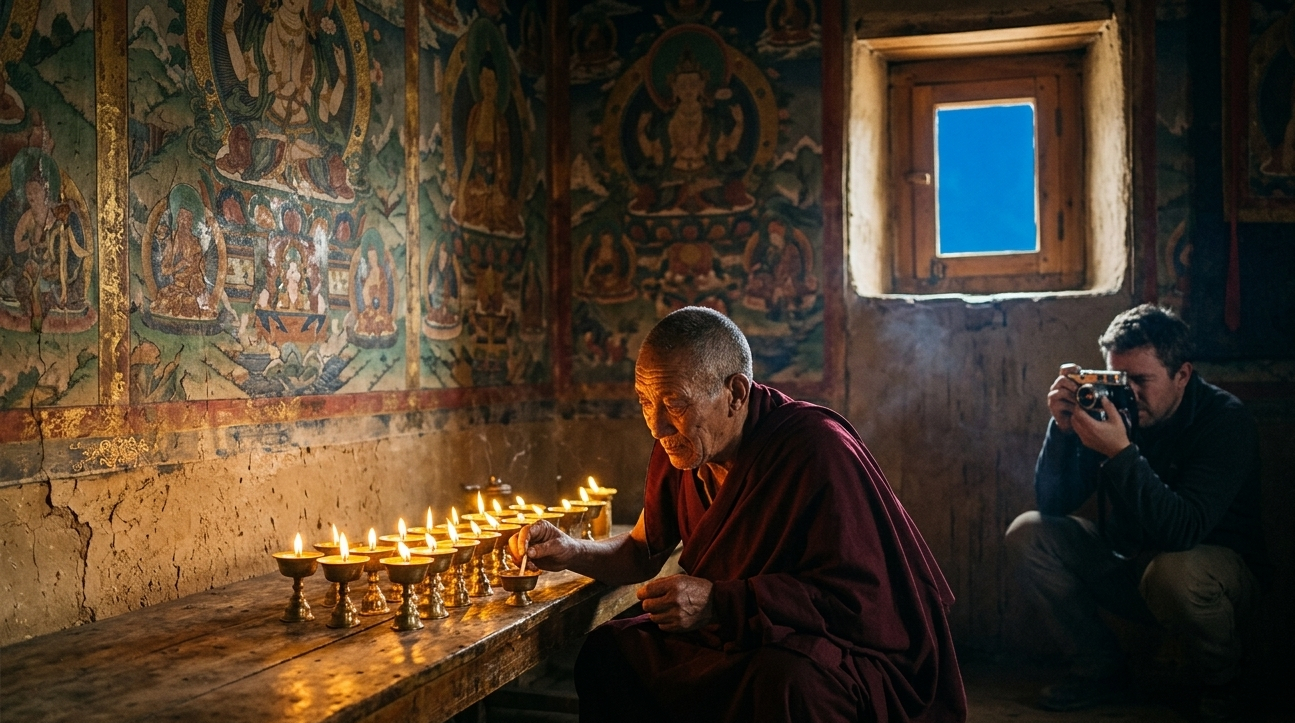
Ancient monastery rituals captured by Sir.Edward
We cannot show you the images that do not yet exist. That is, by definition, impossible.
What we can tell you is what photographers who have returned from these regions consistently describe.
The surprise of the scale — the way the Himalayan high terrain refuses the frame, spilling beyond the edges of even the widest lens, requiring compositional choices that the standard mountain photography vocabulary does not prepare you for.
The quality of the faces — the specific character of people who have not yet learned to perform for a camera, whose expressions in a portrait carry the weight of the landscape they inhabit rather than the self-consciousness of a subject who has been photographed before.
The light — that specific pre-dawn quality at altitude that experienced landscape photographers describe as unlike anything available below 4,000 metres, brief enough to demand complete preparation and complete presence, and extraordinary enough to justify both.
And the particular feeling, in the editing room, of working through images and finding that nothing in any library, any portfolio, any publication you have encountered looks quite like what you are looking at.
That feeling is what every serious photographer is looking for. It is what we design every expedition to produce.
The window is real — and it is finite
The undiscovered nature of these regions is not permanent. Every year, more photographers discover that the standard Himalayan routes have reached the point of visual saturation, and begin asking the same question: where are the images that do not yet exist?
The regions that currently hold that answer are the ones we take photographers to now. In ten years, some of them will have the infrastructure, the photographic documentation, and the established visual vocabulary that makes the question harder to answer.
The photographers who come now arrive in the window that closes slowly but closes certainly. What they find — the specific combination of extraordinary landscape, intact living culture, genuine photographic scarcity, and the light that exists only at altitude in terrain that most cameras have not reached — is available in this form for a limited time.
We know these regions. We know the light, the passes, the communities, and the specific moments that produce the images that do not yet exist. We take one party at a time, with complete attention, to the places where those images are waiting.
The conversation begins whenever you are ready.
Nepal as a Local designs exclusively private photography expeditions to the Himalayas' most undiscovered and least-photographed regions — built entirely around your photographic vision, timed around optimal light, and supported by the local access that transforms a photography trip into a photography expedition. Explore our photo trek programme at nepalasalocal.com/photo-treks or begin the conversation below.